
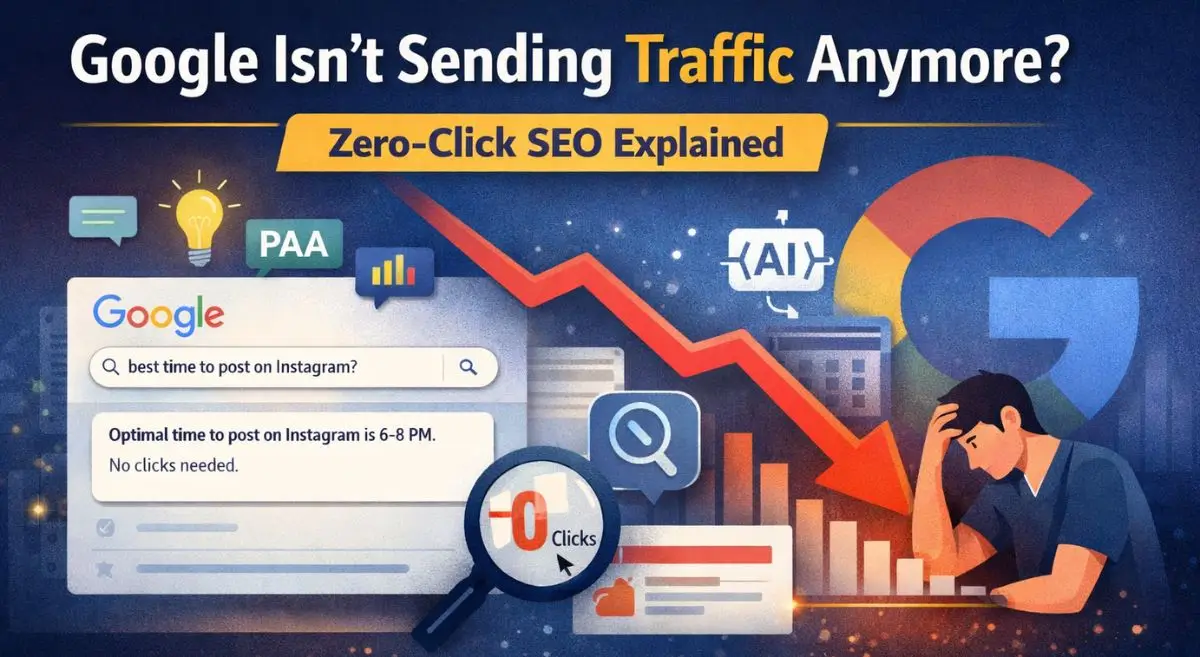
Google Isn’t Sending Traffic Anymore: Zero-Click SEO Explained
If you’ve been checking your analytics lately and thinking “something feels off”, you’re not imagining it.
Your rankings might still look fine.
Your pages may even be sitting on page one.
But traffic? Leads? Actual clicks?
They’re not coming the way they used to.
And no — it’s not always because your SEO is bad.
The uncomfortable truth is this: Google isn’t sending traffic the way it used to.
Welcome to the era of zero-click search.
This article isn’t here to scare you or sell you panic SEO. It’s here to explain what’s actually happening, why it’s happening, and how smart brands are adjusting instead of chasing outdated tactics.
What Zero-Click Search Really Means (In Plain English)
A zero-click search happens when someone searches on Google and gets their answer without clicking any website.
No visit.
No page view.
No session recorded in Analytics.
Google shows:
Featured snippets
“People also ask” boxes
Knowledge panels
AI-generated answers
Maps and local packs
And for a lot of searches, that’s enough.
Example:
You search:
“best time to post on Instagram”
Before:
You’d click a blog
Read an article
Maybe explore more pages
Now:
Google shows a summarized answer
Maybe even an AI explanation
You leave satisfied
No click needed.
Multiply that behavior by millions of searches every day, and you start to see why traffic graphs are dipping across industries.
Why This Is Happening (And Why It’s Not a “Google Penalty”)
Let’s clear one thing up early.
If your traffic is dropping but your rankings haven’t collapsed, you’re probably not penalized.
What’s happening is more structural than that.
Google’s goal has changed.
It’s no longer just:
“Send users to the best websites”
It’s:
“Answer the user as fast as possible, preferably without them leaving Google”
Why?
Because:
Faster answers keep users on Google
Competition with platforms like TikTok and ChatGPT is real
Google is becoming an answer engine, not just a search engine.
And businesses that still think SEO = “rank and wait for clicks” are the ones feeling confused right now.
The Silent Shift Most SEO Blogs Don’t Talk About
Here’s something many SEO articles avoid admitting:
Ranking #1 doesn’t guarantee traffic anymore.
You can rank first and still lose clicks if:
A featured snippet sits above you
An AI answer box steals attention
The user’s intent is satisfied instantly
This is why:
Impressions are up
Click-through rates are down
Bounce rates feel weird
Leads don’t match traffic numbers
It’s not that SEO is dead.
It’s that old SEO assumptions are outdated.
Types of Zero-Click Results You’re Competing With
To understand how to optimize, you need to know what you’re competing against.
1. Featured Snippets
Those short answer boxes at the top of Google.
They:
Pull content from websites
Often answer the full question
Reduce the need to click
Ironically, many snippets come from sites ranking below position #1.
2. AI Answers & Search Generative Experience (SGE)
Google’s AI now:
Combines information
Rewrites it
Presents it as a direct response
This is a big deal.
Your content might be used — but never visited.
3. People Also Ask (PAA)
Expandable questions that keep users inside Google longer.
Each click inside PAA is a click not going to your site.
4. Knowledge Panels & Brand Boxes
Especially common for:
Businesses
Personal brands
Services
Locations
If your brand is there, great for visibility.
But again — not always great for traffic.
So… Is Zero-Click Search Bad for Businesses?
Short answer: It depends on how you adapt.
Zero-click search is bad for:
Websites built only for traffic
Blogs chasing random keywords
Thin content made just to rank
But it can actually help:
Brands
Agencies
Authority-driven businesses
Companies with clear positioning
Because visibility still matters — even without clicks.
People may not visit immediately, but they:
See your name
Remember your brand
Search for you later
Trust you more
That’s why the conversation needs to shift from:
“How do I get more clicks?”
To:
“How do I win visibility and trust before the click?”
Why Traditional SEO Content Is Failing Now
Let’s be honest.
A lot of SEO content still looks like this:
Long introductions with no answers
Keyword-stuffed headings
Rewritten versions of the same article everyone else published
Google’s AI doesn’t need that anymore.
And users definitely don’t.
If your content:
Delays the answer
Talks around the question
Feels generic
Google will happily summarize someone else who gets to the point faster.
What Zero-Click SEO Actually Looks Like (Modern Approach)
Zero-click SEO doesn’t mean “give up on clicks”.
It means designing content for visibility first, then earning deeper engagement.
Here’s how smart brands do it.
1. Answer First, Explain Second
Your content should:
Answer the main question early
Then expand with context, examples, and insight
Not:
300 words of fluff
Then a half-answer buried in the middle
Google favors clarity.
So do humans.
2. Structure Content for Scanning, Not Just Reading
People don’t read articles top to bottom anymore.
They scan.
Use:
Clear H2 and H3 headings
Short paragraphs
Direct language
Natural pauses
This helps:
Users
Search engines
AI summarizers
3. Optimize for Being Quoted, Not Just Clicked
This is a mindset shift.
Instead of asking:
“How do I get them to click?”
Ask:
“If Google quotes someone, why should it be me?”
That means:
Clean definitions
Clear explanations
Confident tone
No filler
4. Build Brand Signals Inside Content
Here’s something many SEOs ignore.
If your content sounds anonymous, Google treats it that way.
Brand signals matter more now:
Consistent voice
Clear expertise
Real-world experience
Opinionated insights (not copied ones)
Even if users don’t click immediately, they remember names that feel real.
Brand Visibility vs Website Traffic (The Hard Truth)
Traffic used to be the main success metric.
Now, it’s incomplete.
You can have:
Lower traffic
Higher quality leads
Better brand recall
Stronger authority
Zero-click search pushes businesses toward brand-first SEO, not just page-first SEO.
This is especially important for:
Agencies
Service providers
Consultants
SaaS brands
If someone sees your name repeatedly in answers, snippets, and discussions, you win long before they visit your site.
What Businesses Should Stop Doing Immediately
If zero-click search is hurting you, stop doing these things:
Chasing only high-volume keywords
Writing content just to “fill the blog”
Copying competitor structures
Obsessing over ranking position alone
Ignoring how Google displays results
SEO today is about how your content appears, not just where it ranks.
How We Approach Zero-Click SEO at Virtual Hub Agency
At Virtual Hub Agency, we don’t chase SEO the way it worked five years ago.
Our focus is:
Visibility over vanity metrics
Authority over empty traffic
Strategy over random posting
That means:
Content designed to be referenced
Human-written explanations, not AI noise
SEO that supports brand growth, not just page views
Because when algorithms change (and they always do), brands with real positioning survive. The rest keep “fixing” traffic drops without addressing the root cause.
What You Should Take Away From This
If your traffic is down, don’t panic.
Ask better questions:
Are people still seeing my brand?
Am I showing up in answers?
Does my content actually help?
Would someone recognize my business name after reading this?
Zero-click search isn’t the end of SEO.
It’s the end of lazy SEO.
And for businesses willing to adapt, it’s an opportunity to stand out while others complain.
One Last Thing Before You Blame Google
Ask yourself honestly:
If Google removed snippets tomorrow…
would your content still deserve attention?
If the answer is no, zero-click search didn’t hurt you.
It exposed a weakness.
Final Thought
Google may not send traffic the way it used to.
But it still decides who gets seen.
And in 2026, visibility, trust, and authority matter more than raw clicks ever did.
If your SEO strategy hasn’t changed yet, that’s probably the real problem.
Google Is Changing Fast. SEO Has to Catch Up
Zero-click search is just one part of the shift.
The bigger change is happening inside AI-powered answer engines — where Google doesn’t just rank pages, it rewrites and summarizes them through AI overviews.
If you want your content to stay visible in this new landscape, you need to understand AEO (Answer Engine Optimization) — not just traditional SEO.
That’s exactly what we break down next.
👉 Learn how brands are optimizing for AI Overviews, answer engines, and summarized search results, instead of fighting for clicks that may never come.
FAQs
Zero-click SEO is the practice of optimizing content to appear in Google answers, snippets, and AI results where users get information without clicking a website.
Traffic drops when Google answers search queries directly through snippets or AI results, reducing the need for users to click on websites.
Zero-click search isn’t bad for SEO, but it changes the goal from clicks to visibility, brand recognition, and authority in search results.
You can optimize for zero-click search by answering questions clearly, structuring content with headings, and providing concise, authoritative explanations.
Yes, zero-click SEO improves brand visibility and trust, which often leads to branded searches and higher-quality leads later.