
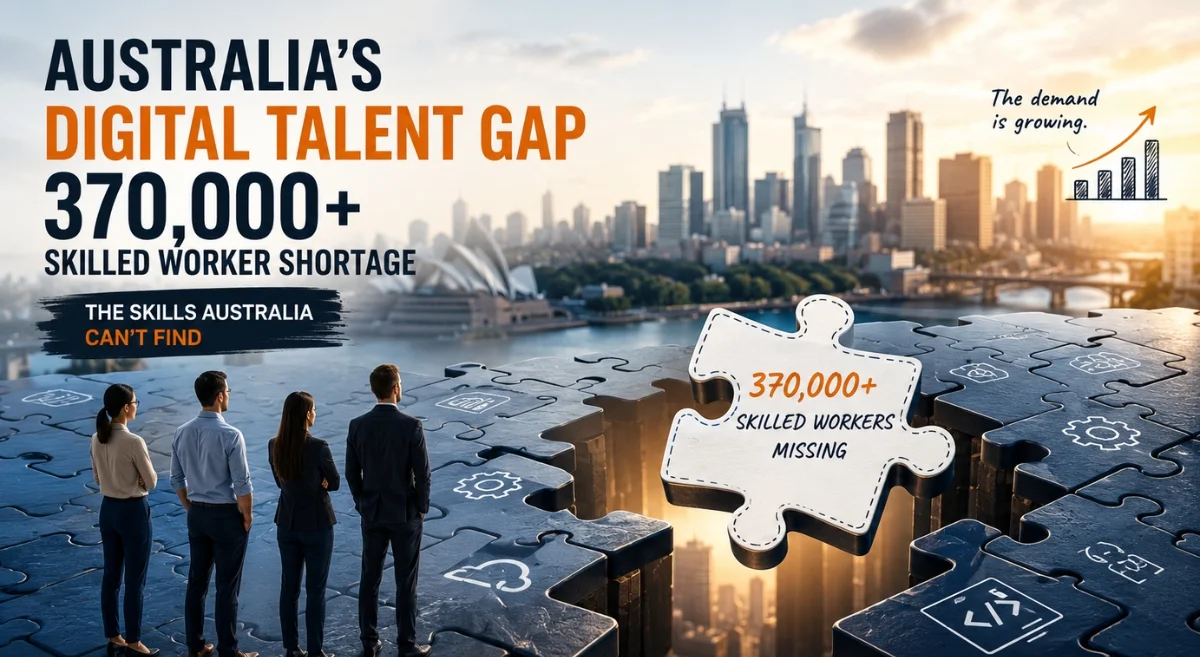
Australia's Digital Talent Gap: What 370,000 Missing Workers Mean for Your SME
If you’ve tried to hire a decent digital marketer or SEO specialist in Australia recently, you already know something feels off. Job ads go quiet. Candidates ghost interviews. The good ones get snapped up by companies with HR teams, signing bonuses, and budgets you can’t compete with.
You’re not imagining it. There’s a documented reason for all of this — and it’s bigger than most people realise.
The Number That Should Be on Every Business Owner's Radar
In 2023, the Future Skills Organisation released its Growing Australia’s Digital Workforce report, and the headline figure hit hard: Australia is projected to face a shortfall of 372,000 digitally skilled workers by 2026. That breaks down into 130,000 unfilled “digital expert” roles — the kind requiring specialist technical skills — and 242,000 “digitally enabled” workers whose jobs depend heavily on digital capabilities they simply don’t have.
This wasn’t a vague warning. The Digital Skills Organisation flagged that Australia’s education and training system had spent two decades failing to keep pace with what the economy actually needs. Schools weren’t teaching the right things. VET providers weren’t producing enough graduates. And the gap between what businesses need and what the talent pool can offer kept getting wider.
Fast forward to 2026, and the Canberra Times reported that even the federal public service is now short more than 61,000 digital professionals, with the shortfall directly threatening $9.7 billion worth of government digital projects. If the government can’t find the people it needs, what chance does your small business have competing for the same candidates?
Why This Hits SMEs Harder Than Anyone Else
Here’s the uncomfortable truth: the talent crisis isn’t hitting every business equally. Large corporations have dedicated HR functions, employer branding budgets, graduate programs, and the kind of salary packages that make a specialist think twice before saying no. SMEs have none of that.
According to KPMG’s Mid-Market Business Review, 27% of Australian mid-market firms are already struggling to recruit or retain talent — and that figure represents businesses with resources most true small businesses can only dream of.
For the typical Aussie SME — a café owner trying to get on Google Maps, a tradie who wants to stop relying on word of mouth, a boutique e-commerce brand competing against international giants — the talent gap creates a specific and painful problem. You either:
- Can’t find a skilled digital marketer at all, and the job sits empty while your competitors rank higher and convert better
- Hire someone underqualified and watch your ad spend leak away with nothing to show for it
- Overpay to attract someone decent, only for them to leave for a better offer six months later
The hidden cost of that last one is particularly brutal. Research suggests turnover costs can exceed 50% of an employee’s annual salary once you factor in recruitment fees, onboarding time, and the weeks it takes for someone new to actually understand your business.
The Real-World Price Tag of Hiring Locally in 2026
Let’s talk money, because this is where SMEs really feel the squeeze.
A Digital Marketing Specialist in Australia now commands a base salary of $80,000 to $95,000, according to current SEEK data. Experienced specialists — the ones who genuinely understand SEO strategy, content performance, paid media, and analytics — regularly command $115,000 or more in Sydney and Melbourne.
But salary is only the beginning. Stack on top of that:
- 12% superannuation (mandatory as of July 2025)
- Payroll tax in most states once you cross payroll thresholds
- Recruitment fees — typically $15,000 to $25,000 for a specialist hire
- Equipment and software costs — another $3,000 to $6,000 to get someone set up properly
- Sick leave, annual leave, public holidays — add roughly 20% buffer on the base
Once you do the real math, a single in-house digital marketing hire is costing you somewhere between $120,000 and $160,000 per year all-in. For a small business doing $1–3M in revenue, that’s not just a line item. That’s a major strategic decision that can break your cash flow if the hire doesn’t work out.
Where the Shortage Is Actually Showing Up for SMEs
The 370,000 number is big and abstract. It helps to understand which specific gaps are hurting small businesses day-to-day.
SEO and organic search
is the most acute. Every business wants to rank on Google. Very few have someone who actually knows how to make that happen — technical audits, keyword strategy, content architecture, link building, and now AI search optimisation on top of it all. The pool of people who can do this properly at an SME budget is tiny.
Social media management
sounds simple until you try to hire for it. Content creation, community management, paid ads, analytics, and platform algorithm knowledge combined in one competent person? Rare and expensive.
Paid advertising (Google Ads, Meta)
is another gap. Running campaigns badly is easy. Running them efficiently — hitting the right audiences, testing creatives, managing bidding strategies, actually hitting ROAS targets — requires someone who has done it repeatedly across multiple industries.
Email marketing and automation
is practically invisible to most SMEs, which is a shame because it consistently delivers the highest ROI of any digital channel. But it requires platform knowledge, copywriting skill, and list management discipline that’s hard to find in one hire.
The Australian digital media market is valued at $25.2 billion USD in 2026, and digital ad spend has already surpassed $15 billion annually. The demand is there. The human capacity to service it isn’t.
What Are Smart Australian SMEs Actually Doing?
Some businesses are sitting on their hands, hoping things improve. But the ones actually growing aren’t waiting around.
Working with specialist agencies instead of hiring in-house.
This is one of the most practical pivots an SME can make. A good agency gives you an entire team — strategists, copywriters, paid media specialists, SEO analysts — for a fraction of what a single senior in-house hire would cost. You’re also not exposed to the resignation risk. Our SEO and digital marketing services are built specifically around the kind of flexibility and expertise that SMEs need without the overhead of building an internal team.
Investing in training existing staff.
Some businesses are identifying team members with aptitude and putting them through structured digital marketing courses. It takes time, but it builds internal capability that stays with the business.
Being more strategic about channels.
Rather than spreading thin across every platform, smarter SMEs are picking one or two channels and doing them properly. A focused local SEO strategy paired with consistent content often outperforms a scattered approach across paid social, SEO, email, and more — all done at surface level.
Setting realistic expectations about timelines.
The talent gap has made it harder to get results fast, but it’s also made it clearer why sustainable, long-term strategies like building domain authority through quality content and backlinks matter more than short-term hacks.
What This Means for Your Business Right Now
The digital talent gap isn’t just an economic statistic. It’s the reason your competitors who seem to be doing everything right online probably aren’t doing it themselves — they’ve figured out how to get the expertise without the full-time hire.
Jobs and Skills Australia continues to flag digital roles as priority shortage occupations. That status isn’t going away any time soon. The training pipeline that would fix this takes years to produce graduates, and demand is growing faster than supply regardless.
For Australian SMEs, the practical takeaway is this: the businesses that will win in this environment are the ones that stop treating digital marketing as an internal function to be filled with a single hire, and start treating it as a specialised capability to be sourced strategically.
That might mean a mix of a part-time internal coordinator and external agency support. It might mean outsourcing entirely to a team that already has the depth of expertise you need. It might mean auditing your current digital spend and consolidating it into the one or two channels that actually move the needle for your specific business.
Whatever the approach, doing nothing is the most expensive option of all. When 54% of Australian business leaders are already citing workforce capability as their single greatest barrier to technology adoption, standing still while your competitors figure it out is a strategy — just not a good one.
Frequently Asked Questions
Australia is projected to face a shortage of more than 370,000 digitally skilled workers, split between technical digital experts and workers who need digital skills as part of their broader roles. This shortage has been growing for years due to underinvestment in digital training and education, and is now directly impacting businesses across every sector.
They can, but the combination of high salary expectations ($80,000–$115,000+), hidden employment costs like superannuation and payroll tax, and the scarcity of genuinely skilled candidates makes it a difficult and expensive proposition. Many SMEs either can’t find candidates or can’t afford the ones they find.
For many Australian SMEs, yes. Working with a specialist agency gives you access to a full team of experts — SEO, content, paid ads, social media — without the fixed costs and risk of a full-time hire. It also means you’re not exposed to the productivity gap that comes when a solo in-house hire leaves.
The Future Skills Organisation and other bodies suggest this is a multi-year challenge. Building a pipeline of skilled digital workers takes time, and current demand is growing faster than supply. Businesses are better served by adapting to this reality now rather than waiting for the market to correct itself.
SEO, paid search advertising (Google Ads), Meta advertising, content marketing, email marketing and automation, and data analytics are consistently among the most sought-after skills — and the hardest to find at SME-friendly budget levels.
Directly competing for the same full-time hires is difficult. But SMEs that work with specialist agencies, invest in upskilling existing staff, or focus their digital efforts on a smaller number of high-impact channels can absolutely compete — and win — online even in this environment.
Virtual Hub Agency works with small and medium businesses across Australia, the UK, US, UAE, and Canada to build digital marketing strategies that fit real budgets and deliver real results. Explore our SEO services, social media marketing, and content marketing to see how we can help close the gap for your business.